It’s a moment that can make or break a match: the referee points to the penalty spot. These pivotal decisions, along with
penalty shootouts, often define the outcome of crucial games. But then, there’s a pause. Players surround the official, an earpiece is touched, and all eyes turn to the dreaded, or celebrated, VAR review. You’ve likely felt the frustration, confusion, or even relief that follows. You’re left wondering what exactly is happening behind the scenes. This guide is here to pull back the curtain. We will walk you through the entire process, from the control room to the pitch-side monitor, so you’ll know exactly how VAR works in football penalty decisions.
The Short Answer: VAR and Penalties in 30 Seconds
- Automatic Checks: The Video Assistant Referee (VAR) team automatically checks every potential penalty incident in the background without stopping the game.
- High Bar for Intervention: VAR only advises the on-field referee to review a decision if a “clear and obvious error” has been made. It doesn’t get involved in 50/50 calls.
- Referee is in Charge: The on-field referee always makes the final decision, often after reviewing the footage themselves on a pitch-side monitor.
What is VAR? Understanding the System and its Philosophy
Before we dive into the step-by-step process, it’s essential to understand the foundation of VAR. It’s not just about technology; it’s guided by a very specific principle.
The Official VAR Philosophy: “Minimum Interference, Maximum Benefit”
This phrase, straight from the International Football Association Board (IFAB) who sets the rules, is the key to everything. The goal of VAR isn’t to re-referee the entire game from a studio. Instead, its purpose is to act as a safety net to correct major, undeniable mistakes. Think of it as intervening only for the big, game-changing errors that everyone can see are wrong on a replay, not for minor debates.
The VAR Team: Who is in the Control Room?
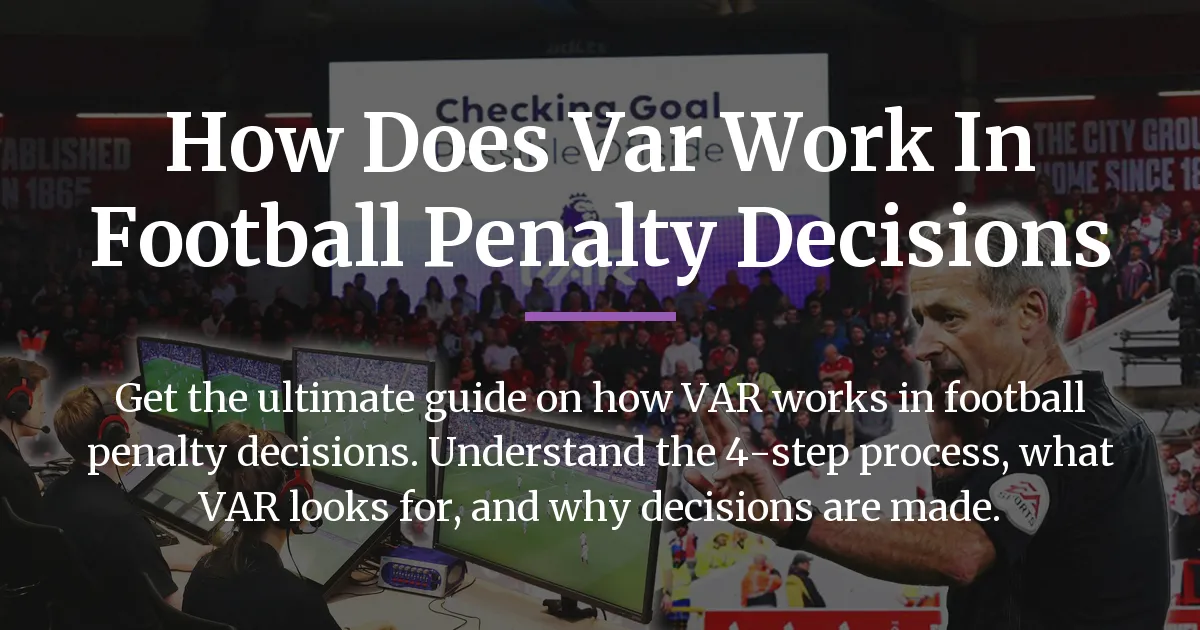
It’s not just one person watching a TV. The VAR team is a group of highly trained officials working together in a central location, often called the Video Operation Room (VOR). The team typically consists of:
- The VAR: The main Video Assistant Referee, usually a current or recently retired top-level referee, who leads the process and communicates with the on-field official.
- The AVAR: An Assistant VAR who focuses on keeping up with the live action while the main VAR is conducting a review, so nothing is missed.
- The Replay Operator (RO): A technician who provides the best camera angles and replay speeds as requested by the VAR.
The Technology at Their Fingertips
To do their job, this team has a powerful set of tools. They have access to every single camera angle the broadcasters are using, including exclusive tactical cameras not shown on the main feed. They can watch plays in real-time, slow-motion, and even super-slow-motion to identify the exact point of contact. This setup also includes specialized software, like the virtual offside line technology used to make precise offside judgments.
The 4-Step Process: How a VAR Penalty Check Actually Works
Now that we know who is involved and what their guiding principle is, let’s break down the journey from a foul in the box to a final decision. This is how VAR works in football penalty decisions in real-time.
Step 1: The “Silent Check” on Every Incident
From the first whistle to the last, the VAR team is constantly watching the game. For every tackle, handball shout, or tumble inside the penalty area, they are performing what’s called a “silent check.” The game continues uninterrupted on the pitch. In the vast majority of cases, the VAR team agrees with the on-field referee’s decision (or non-decision), and the check is completed in seconds without anyone even knowing it happened. No action is needed, and the game flows on.
Step 2: Identifying a “Clear and Obvious Error”
The silent check only becomes a formal review if the VAR spots a potential “clear and obvious error.” This is the most crucial and often most misunderstood part of the process. It’s not about whether the VAR official would have made a different decision. The question is: Was the on-field referee’s decision demonstrably wrong? It’s for mistakes so apparent that a replay makes them undeniable, like a referee awarding a penalty for a clear dive with no contact, or missing a blatant trip that was a clear foul.
Step 3: Communication from VAR to Referee
If the VAR believes a clear error has occurred, they will activate their earpiece to speak with the on-field referee. They will not tell the referee what to do. Instead, they will describe what they see on the video footage. For a penalty, the VAR might say something like, “I recommend an on-field review for a possible penalty. The defender made no contact with the ball and clearly tripped the attacker.” This initiates the next step.
Step 4: The On-Field Review (OFR) and Final Decision
Following this recommendation, the referee will signal by making the shape of a TV screen with their hands and jog over to the pitch-side monitor. Here, they will watch the replays of the incident, often at different speeds and angles, as prepared by the VAR team. This is a vital moment because it reinforces who is in control. The VAR only recommends; the on-field referee, having seen the evidence for themselves, makes the final, binding decision. They can either stick with their original call, overturn it to award a penalty, or cancel a penalty they had previously given.
What Does VAR Look For? Key Penalty Scenarios Explained
When reviewing a penalty, the VAR isn’t just looking for a foul. They are checking for several specific things based on the Laws of the Game.
Subjective Decisions: Fouls, Trips, and Challenges
This is where the “clear and obvious” threshold is most important. For a trip or foul challenge, VAR will typically intervene in two main situations: if the referee awards a penalty when there was clearly no contact, or if the referee misses an obvious foul that should have been a penalty. They will not get involved if it’s just a matter of opinion on a slight touch or a 50/50 challenge. They use normal speed to judge the intensity of a challenge and slow-motion to find the exact point of contact.
The Handball Rule: Intent vs. Unnatural Position
The handball rule is famously controversial and seems to change every season. VAR’s job is to apply the rule as it is written. They check if the player’s arm made their body “unnaturally bigger,” like having an arm extended far from the body. They also check the distance the ball traveled and if the player had any chance to avoid it. While it remains a point of debate, VAR provides the referee with the best angles to judge if a hand or arm position was illegal according to the current interpretation of the law.
Location of the Foul: Inside or Outside the Box?
This is a factual decision and one area where VAR is incredibly effective. Sometimes a foul happens right on the edge of the penalty area, and it’s impossible for the referee to see with the naked eye whether it was inside or out. VAR can use its camera angles and line technology to freeze the frame at the exact moment of the foul and determine with precision if it occurred on or inside the penalty area line, which would result in a penalty.
Attacking Phase of Play (APP): Fouls or Offsides Before the Penalty
VAR can also disallow a penalty if there was a clear infraction by the attacking team in the immediate build-up. This is known as the Attacking Phase of Play (APP). For example, if a player who wins a penalty was in an
offside position when they received the ball, or if a teammate committed a clear foul to win back possession just before the penalty incident, VAR can recommend that the penalty be canceled.
VAR in Action: Real-World Penalty Case Studies
Theory is one thing, but seeing how the process works with examples makes it much clearer. Let’s walk through a few common scenarios.
Case Study 1: A Penalty Awarded by VAR after being Missed
The Scene: An attacker dribbles into the box and is tripped by a defender’s trailing leg. The referee, whose view was blocked, waves play on.
The Process:
- Silent Check: The VAR team instantly reviews the tackle.
- Error Identified: The replay clearly shows the defender made no contact with the ball and tripped the attacker. This is a “clear and obvious error.”
- Communication: The VAR contacts the referee: “I recommend an on-field review for a missed penalty incident.”
- OFR & Decision: The referee watches the replay on the monitor, sees the clear trip, and overturns their original decision. They point to the penalty spot.
Case Study 2: A Penalty Overturned by VAR after an On-Field Review
The Scene: An attacker goes down in the box under a challenge, and the referee immediately awards a penalty. The defending team protests.
The Process:
- Silent Check: The VAR reviews the incident.
- Error Identified: Slow-motion replay shows the defender cleanly won the ball and there was minimal, if any, contact on the attacker. Awarding the penalty was a “clear and obvious error.”
- Communication: The VAR recommends an on-field review to check the foul decision.
- OFR & Decision: The referee watches the replay, sees the defender won the ball, and realizes their initial decision was wrong. They cancel the penalty and restart play with a dropped ball.
Case Study 3: A Controversial Handball Decision Explained
The Scene: A cross is hit into the box and strikes a defender’s arm. The referee doesn’t award a penalty, judging the arm was in a natural position.
The Process:
- Silent Check: The VAR team reviews the handball.
- Error Identified: The replay shows the defender’s arm was extended high and away from their body, making their silhouette “unnaturally bigger.” According to the rules, this is a handball offense. The on-field miss is a “clear and obvious error.”
- Communication: The VAR recommends a review for a possible handball penalty.
- OFR & Decision: The referee reviews the footage, sees the unnatural arm position, and awards the penalty, even though it was controversial in real-time.
Common Controversies and Criticisms of VAR for Penalties
Even with this structured process, VAR is far from universally loved. It’s important to acknowledge the common frustrations that fans and players often have.
The “Clear and Obvious” Debate: Is it too Subjective?
The biggest criticism is that the “clear and obvious” threshold is still open to human interpretation. What one official considers a clear error, another might see as a 50/50 call. This inconsistency between different matches or leagues is a major source of frustration and debate among fans.
The Pace of the Game: How Long do Checks Take?
Lengthy VAR checks can disrupt the flow and energy of a match. While silent checks are quick, an On-Field Review can take several minutes, leaving players and fans waiting in suspense. This can kill momentum and drain the spontaneous joy or despair from a goal or penalty decision.
Why Don’t Referees Always Follow the VAR’s Advice?
While it’s rare, a referee can look at the monitor and decide to stick with their original decision, even if the VAR recommended a review. This happens because the referee is the ultimate authority. They might feel the replay doesn’t show a clear error, or that the real-time feel of the incident was different from what the slow-motion replay suggests. This reinforces their authority but can sometimes lead to even more confusion.
Frequently Asked Questions
1. Can a player ask the referee for a VAR review?
No. Players, managers, or coaching staff cannot request a VAR review. Any player who excessively pressures the referee or makes the “TV screen” signal can be shown a
yellow card.
2. What are the four game-changing situations VAR can review?
VAR can only intervene for potential clear and obvious errors related to four specific scenarios: goals, penalty decisions,
direct red card incidents, and cases of mistaken identity (e.g., showing a card to the wrong player).
3. Does VAR use slow-motion for every decision?
No, they use different speeds for different purposes. Slow-motion is primarily used to find the exact point of contact in a foul or a handball. However, for judging the intensity of a foul (e.g., whether it was a reckless challenge), the officials are encouraged to look at the replay in real-time speed.
4. Who makes the final penalty decision, the VAR or the referee?
The on-field referee always makes the final decision. The VAR is an assistant who provides information and recommends a review, but the referee on the pitch has the last word.
5. Why can’t VAR intervene on yellow cards or free kicks outside the box?
This goes back to the “minimum interference” philosophy. To keep the game flowing, VAR’s scope is limited to only the most critical, match-deciding situations. Reviewing every yellow card or free kick would lead to constant interruptions and fundamentally change the nature of the referee’s job.
6. How do they draw the lines for offside in the build-up to a penalty?
The VAR system uses 3D mapping technology. The replay operators place points on the attacker’s and defender’s relevant body parts, and the software creates a virtual, computer-generated line on the pitch to determine with high accuracy whether a player was offside.
Conclusion: The Future of VAR in Football
So, how does VAR work in football penalty decisions? It’s a human-led, technology-assisted process designed to correct clear errors, not to achieve 100% perfection on every call. It follows a strict 4-step protocol, guided by the principle of minimum interference, and always leaves the final say in the hands of the on-field referee. While it remains a topic of passionate debate, VAR is a tool that continues to evolve. As the technology improves and officials gain more experience, the hope is that it will become a more consistent and accepted part of the beautiful game, ensuring that the most important decisions are also the most accurate ones.