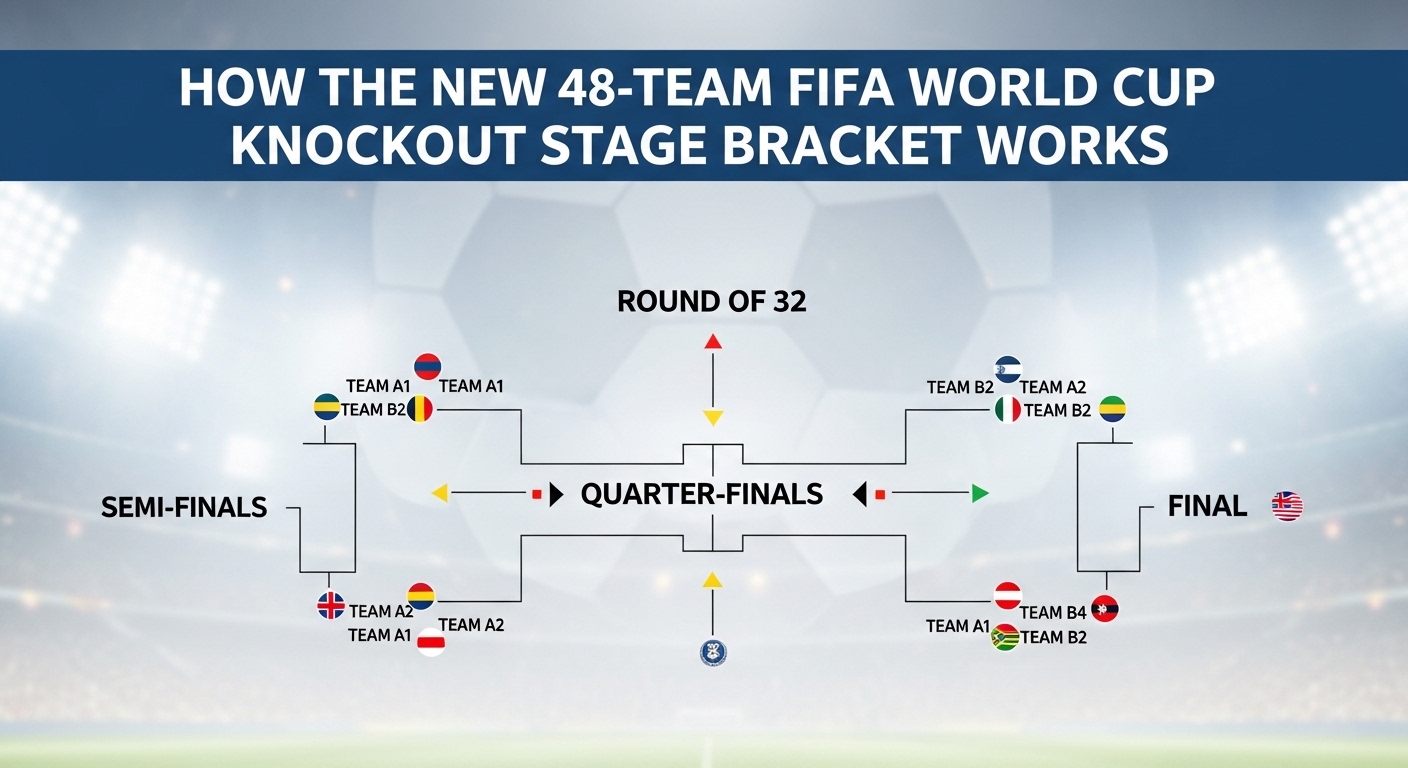
The 2026 FIFA World Cup will mark a historic expansion to 48 teams, fundamentally reshaping the tournament’s structure. This article explains how the knockout stage bracket operates under the new format, detailing tie-breakers, scheduling, and strategic implications for teams advancing from the group phase.
Understanding the Group Stage Qualification
In the 48-team format, the initial round consists of 12 groups of four teams each. Each team plays three matches within their group, earning points for wins (3), draws (1), or losses (0). The top two teams from every group advance to the knockout stage, resulting in 32 qualifiers entering the second phase.
| Group Phase | Teams per Group | Matches per Team | Qualifiers per Group |
|---|---|---|---|
| Round 1 | 4 | 3 | 2 |
| Total Groups | – | – | 12 |
| Knockout Entrants | – | – | 32 |
This ensures that only the strongest teams progress, maintaining competitive integrity while accommodating more nations.
Knockout Stage Format and Bracket Structure
The knockout stage begins with the Round of 32, followed by the Round of 16, quarterfinals, semifinals, third-place playoff, and final. All matches are single-elimination, meaning a loss ends a team’s campaign unless they win.
The bracket is seeded based on group standings: the first-placed team from one group faces the runner-up from another predetermined group. For example, Group A winner plays Group B runner-up, Group C winner faces Group D runner-up, and so on, ensuring balanced matchups.
Below is a simplified representation of the bracket alignment:
- Round of 32:
- Group A Winner vs. Group B Runner-up
- Group C Winner vs. Group D Runner-up
- Group E Winner vs. Group F Runner-up
- Group G Winner vs. Group H Runner-up
- Group A Runner-up vs. Group B Winner
- Group C Runner-up vs. Group D Winner
- Group E Runner-up vs. Group F Winner
- Group G Runner-up vs. Group H Winner
- Round of 16:
- Winners of Matches 1 & 8
- Winners of Matches 2 & 7
- Winners of Matches 3 & 6
- Winners of Matches 4 & 5
- Winners of Matches 9 & 16
- Winners of Matches 10 & 15
- Winners of Matches 11 & 14
- Winners of Matches 12 & 13
This seeding system prevents strong groups from meeting too early, preserving excitement throughout the knockout rounds.
Tie-Breaker Protocols for Draws
If a knockout match ends in a draw after 90 minutes, the tie proceeds to extra time (two 15-minute halves). If still level, the winner is determined by a penalty shootout.
FIFA has not introduced new tie-breakers beyond standard procedures; however, all decisions follow Article 13 of the Laws of the Game. There is no aggregate scoring or replay system in knockout stages.
Historically, penalty shootouts have decided numerous decisive matches, including multiple finals (e.g., France 1998, Brazil 2002). Teams must prepare thoroughly for this high-pressure scenario.
Scheduling and Match Timing
The knockout stage spans approximately three weeks, with matches played across multiple host cities. Each round typically features games on consecutive days, allowing fans to follow the action without excessive gaps.
All knockout matches begin at 18:00 local time (UTC-6 to UTC+3 depending on venue), aligning with prime-time viewing in major markets like North America, Europe, and Asia. The final is scheduled for mid-July, avoiding extreme summer heat in most stadiums.
FIFA coordinates broadcast windows to maximize global audience reach, with staggered kickoff times for regional audiences where necessary.
Strategic Implications for Teams
With 48 teams, more nations compete for fewer knockout slots, increasing unpredictability. However, the expanded group phase allows smaller footballing nations a realistic chance to qualify, fostering broader engagement.
For qualifying teams, the key is to finish as group winners rather than runners-up when possible. Being a runner-up risks facing a stronger opponent in the Round of 32, especially if paired against a top seed.
Managers must balance squad rotation during the group stage to avoid fatigue ahead of tight knockout schedules. Injuries or suspensions can be catastrophic once the elimination phase begins.
Historical Context and Format Evolution
The last 32-team World Cup was held in 2022 in Qatar. Before that, the tournament used 32 teams since 1998, following an expansion from 24 teams in 1982. The 1934 edition featured just 16 teams, and the inaugural 1930 World Cup had 13 participants.
The 48-team proposal was approved by FIFA members in March 2017, citing commercial growth and global inclusivity. Critics argued it dilutes quality, but data shows average goals per game remain consistent—around 2.7–2.9 since 1998.
Notably, the 2026 edition will be hosted jointly by the United States, Canada, and Mexico, marking the first time three countries co-host. This adds logistical complexity but also increases stadium availability and fan accessibility.
Impact on the 2026 World Cup
The 2026 tournament will feature 164 matches—up from 64 in 2022—including 104 in the group stage and 70 in the knockout phase. While more games boost revenue and exposure, they also stretch player fitness and raise fixture congestion concerns.
UEFA and other confederations have expressed reservations about additional matches during international windows. FIFA has committed to adhering to existing scheduling protocols, but clubs may face challenges balancing domestic leagues with national team duties.
Fan experience remains central: more games mean more opportunities to attend live, though ticket allocation will be highly competitive. The knockout bracket’s design aims to reward consistency while minimizing early upsets.
Frequently Asked Questions
Q: Can a team advance to the knockout stage with zero points?
A: No. To advance, a team must finish among the top two in its group. With 12 groups and 48 teams, even losing all three group games typically results in bottom-four placement, barring extreme goal differences or tie-breaker anomalies.
Q: How many teams get eliminated in the group stage?
A: Exactly 36 teams are eliminated after the group phase. Since 12 groups send 24 teams forward, 24 drop out immediately. Of those 24, half (12) may survive if tied on points and favorable tie-breakers apply, but generally, 36 leave without progressing.
Q: Will there be replays if a knockout match is drawn?
A: No. FIFA does not use replays in World Cup knockout stages. Extra time and penalties are the sole methods to determine advancement.
Q: Are the knockout fixtures pre-determined before the group stage?
A: Yes. The bracket is fixed at the start of the tournament. Group winners and runners-up are slotted into specific slots based on confederation allocations and seeding rules established by FIFA.
Data Summary Box / Quick Reference
- Group Phase: 12 groups × 4 teams = 48 entrants
- Knockout Entrants: Top 2 from each group = 32 teams
- Bracket Seeding: Group A Winner vs. Group B Runner-up, etc.
- Tie-Breakers: Extra time → Penalty Shootout
- Final Match: Scheduled for mid-July 2026
- Total Knockout Matches: 31 (Round of 32 to Final)
Conclusion
The 48-team FIFA World Cup introduces a dynamic and inclusive format, expanding opportunities for global participation while maintaining the drama of single-elimination knockout football. Understanding the bracket structure, tie-breaker protocols, and scheduling nuances empowers fans and analysts alike to appreciate the strategic depth of the world’s most-watched sporting event. As the 2026 edition approaches, anticipation builds for what promises to be an unprecedented chapter in football history.