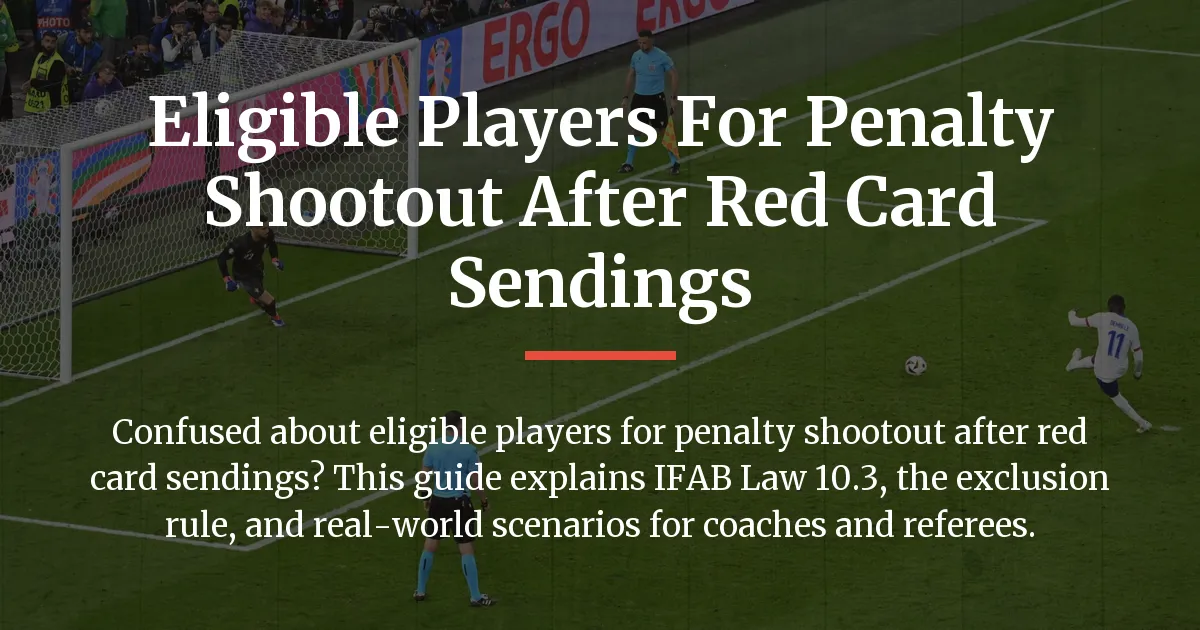
A player gets sent off during extra time. The final whistle blows. Now the tension shifts to a penalty shootout. One team stands with 10 players. The other has 11. Who is actually allowed to step up and strike the ball? It’s not as simple as just looking at who is left on the pitch. Understanding the nuances of eligible players for penalty shootout after red card sendings can mean the difference between a tactical masterstroke and a tournament-ending mistake.
This guide breaks down IFAB Law 10.3. We’ll demystify the “equal numbers” principle. Then we’ll walk through every possible scenario. Whether you’re a coach, a referee, or just a die-hard fan, you’ll finish this article with a clear grasp of what happens when red cards alter the landscape of a shootout.
Eligible Players for Penalty Shootout After Red Card Sendings: The 2024 Rule
Under IFAB rules, only players on the pitch at the end of extra time can participate in a penalty shootout.Eligible Players for Penalty Shootout After Red Card Sendings: The 2024 Rule. If a team receives a red card and finishes shorthanded, the opposing team must actively “reduce to equate” by excluding players to match the lower roster number, maintaining complete shootout fairness.The Core Rule: The ‘Equal Numbers’ Principle
What IFAB Law 10.3 Actually Says
The International Football Association Board is crystal clear. If one team finishes the match with more players than their opponent, they must reduce their numbers to match the opposition before the shootout begins. The referee needs to be formally notified of exactly which players are being excluded. This isn’t just bureaucracy. It’s a fundamental fairness mechanism. It stops a team from leveraging numerical superiority to gain an advantage in rest or selection options.
The Excluded Player’s Status
Once a player is excluded to balance the numbers, they are effectively removed from the shootout proceedings. They must leave the field of play entirely. Usually that means heading to the dressing room or technical area. But there’s a critical exception. If a goalkeeper gets injured or becomes ill before or during the kicks, an excluded player can step in to replace them. That player can then serve as the goalkeeper. However, they cannot take a penalty kick themselves until the next round, provided the original keeper had already taken theirs.
Step-by-Step: Managing Red Cards Before a Shootout
When a red card causes an imbalance, the procedure needs precision to avoid confusion. Here’s how it typically unfolds:
A common error is assuming an excluded player can just hang back on the sidelines. They must leave the playing area. Failure to comply or properly inform the referee can lead to delays, confusion, and even the risk of a forfeited kick.
Real-World Scenarios: How It Plays Out
Theoretical rules are one thing. Seeing them in action is another. Here is how the rules for eligible players for penalty shootout after red card sendings apply in high-pressure situations:
Strategic Implications for Coaches
Beyond the rules, there’s a strategic game to play. If you’re forced to exclude a player, don’t pick at random. Identify your weakest penalty takers. Or look for those who are clearly fatigued. By removing a player who wasn’t likely to score anyway, you tighten your selection to the most clinical shooters.
Some managers use this as a psychological tool too. Choose to exclude a player early and with confidence. It signals to the opposition that you’re undeterred by the numerical reduction. Just be careful to track every eligible player. If someone wanders off to the bathroom or locker room and isn’t present for their turn, it’s recorded as a missed kick.
Coaches should also be aware that, aside from red card exclusions, there are specific extra time substitution limit rules for knockout phase matches that dictate how the squad size may have been altered before the shootout even began.
Common Mistakes & Misconceptions
Conclusion
At its core, the policy regarding eligible players for penalty shootout after red card sendings is designed to keep the playing field level. The math is straightforward. But the tactical execution requires a cool head. Coaches need to be decisive about who they exclude. Players must remain alert and present. By mastering these regulations, you ensure your team stays focused on the goal rather than getting tangled in procedural errors. Next time you watch a match end in penalties, look closer at the sidelines. The tactical decisions made before the first kick could very well decide who takes home the trophy.
For those interested in how other disciplinary issues impact tournament outcomes, you can also review the red card suspension carryover rules from qualifiers to tournament – 2026 FIFA regulation to understand the broader context of player availability.
Finally, if you are looking to learn more about advanced shootout mechanics, be sure to check out our deep dive into the ABBA penalty shootout format rules.